
A movie database is more than a place to store titles. It is the structure…

WordPress Movie Website SEO
A movie site can hold hundreds of titles and still be hard to find, because search engines read pages one by one, not as a library. Each title page, series page, and people page must stand alone with a clear title, a useful description, and structured information about what it is. WordPress movie website SEO is therefore page work first and promotion second: the site must be readable before it can be recommended.
This guide explains the parts that matter: title and description templates, standalone pages, structured data, internal linking, a search-friendly catalog, and performance basics. No ranking is promised and no price is quoted, because WordPress movie website SEO improves findability; it does not guarantee a position.
Quick answer
For a standard movie website, SEO for WordPress starts with five jobs done together: consistent title and description templates, standalone title, series, and people pages, structured data that names each page type, internal links that connect titles to people and genres, and a catalog viewers can search and filter predictably.
- Templates first: one title and description pattern, filled per title.
- Pages second: every title, series, and person page readable on its own.
- Structured data third: each page type labelled for search engines.
- Linking fourth: titles linked to people, genres, and collections.
- Testing fifth: real pages checked in search results, not assumed correct.
Follow that order, and WordPress movie website SEO stops being a list of settings and becomes a checklist the site can be judged against.
1. What search engines need from a movie site
A search engine meets a movie site as a set of pages, and it judges each page on its own. A title page should say, in its title and description, which film it is, its year, and its genre, without opening the page. A series page should show its seasons in order, and a people page should list that person’s films and series.
That page-by-page reading is why WordPress movie website SEO cannot rest on catalog size alone. A thousand half-finished pages, with thin descriptions or missing cast lists, read worse than a smaller catalog where every page is complete. Check the site the way a search engine meets it: open a title page, a series page, and a people page, and ask whether each one explains itself.

2. Title and description templates
No small team writes a unique title and description for every title by hand, so templates do that work. A template fills placeholders from the title’s own data: the title, the year, the genre, the overview, and the site name. Every page then follows the same pattern while still describing its own film.
Consistency is the point of WordPress movie website SEO. When titles follow one pattern, viewers and search engines learn what each part means, and a missing year or genre stands out as a gap to fix rather than hiding in varied wording. Review templates after import, because WordPress movie website SEO is only as good as the metadata that fills it.
3. Standalone title, series, and people pages
In WordPress movie website SEO, each page type must stand alone. A title page needs its cast, genres, year, description, and rating in one place. A series page needs its seasons and episodes in order, so a reader can follow the series without guessing. A people page needs that person’s films and series, linked back to their title pages.
Thin pages hurt WordPress movie website SEO here. A title page with only a poster and a play button gives a search engine little to describe, and a people page that is only a name gives it nothing at all. Completeness checks belong in the routine: after import, open a sample of each page type and confirm each one reads as a finished page.
4. Structured data that names each page
In WordPress movie website SEO, structured data tells a search engine what a page is, in a form it can read directly. Movie, TV series, season, episode, and person pages each carry their own structured data, describing the title, cast, and genres where they apply. That labelling helps a search engine present the page accurately, rather than guessing from layout alone.
Structured data does not replace visible content in WordPress movie website SEO. A page whose structured data claims a cast list the visible page does not show is inconsistent. Keep the two in step: whatever the structured data says, the page itself should show.
5. Internal linking and catalog structure
In WordPress movie website SEO, internal links are how both viewers and search engines move through a catalog. A title page should link to its cast members, its genres, and its collections, and a people page should link back to every title that person worked on. Those links turn isolated pages into a browsable site.
Taxonomies keep those links honest. Genre, year, country, language, and network labels must be spelled the same everywhere, because a genre spelled two ways splits one browsing path into two and weakens every link that uses it. In WordPress movie website SEO, check links after import, especially for new genres and new people, where a first spelling mistake spreads quietly.

6. A search-friendly catalog
Search is where WordPress movie website SEO is tested most sharply. Search should cover titles, people, and genres, and filters for genre, year, country, and language should narrow results in a way a viewer can predict before clicking. A catalog that is easy to search is also easy for a search engine to understand.
Empty results deserve the same care. A page that says plainly that nothing matched, suggests a broader genre or spelling, and offers a content-request form where enabled, keeps viewers on the site instead of sending them back to search. Treat search as a routine: check it regularly, and fix the labels behind the queries that return nothing useful.
7. Performance basics
Performance supports WordPress movie website SEO without replacing it. Pages should load promptly on phones and larger screens, playback should be tested on slow, fast, and changing connections, and the site should be retested after updates, because an update can change playback or settings without warning.
Keep WordPress movie website SEO performance checks simple and regular: open real title pages on a phone, play a title, search for a genre, and save a film to a watchlist. If any step feels slow or broken, fix it before adding more titles.
8. Movie website SEO checklist
The table below turns the points above into a checklist, using only points already explained here. Use it for launch and later reviews, skipping a row only where it genuinely does not apply.
| Part | Done when |
|---|---|
| Templates consistent | Title and description pattern filled per title |
| Pages standalone | Title, series, and people pages each read alone |
| Structured data labelled | Each page type carries its own structured data |
| Links connected | Titles link to people, genres, and collections |
| Search predictable | Search covers titles, people, and genres |
| Labels consistent | Genre, year, country, and language spelled alike |
| Performance checked | Real pages tested on phones and slow connections |
| Rights current | Only titles the site has rights to are offered for playback |
Work through the table in order: templates, pages, structured data, linking, then search and performance.
9. WordPress movie website SEO with MovieEngine
For a WordPress movie site, the SEO work sits inside a larger build: catalog, title pages, search, watchlist, and playback must work together. Movie Engine (Free 1.0.8 and Pro 1.0.8, by ThemePul) provides SEO title and description templates in Free, with placeholders for the title, the year, the genre, the overview, and the site name, plus JSON-LD schema for movie, TV series, season, episode, and person pages, and Open Graph and Twitter Card controls.
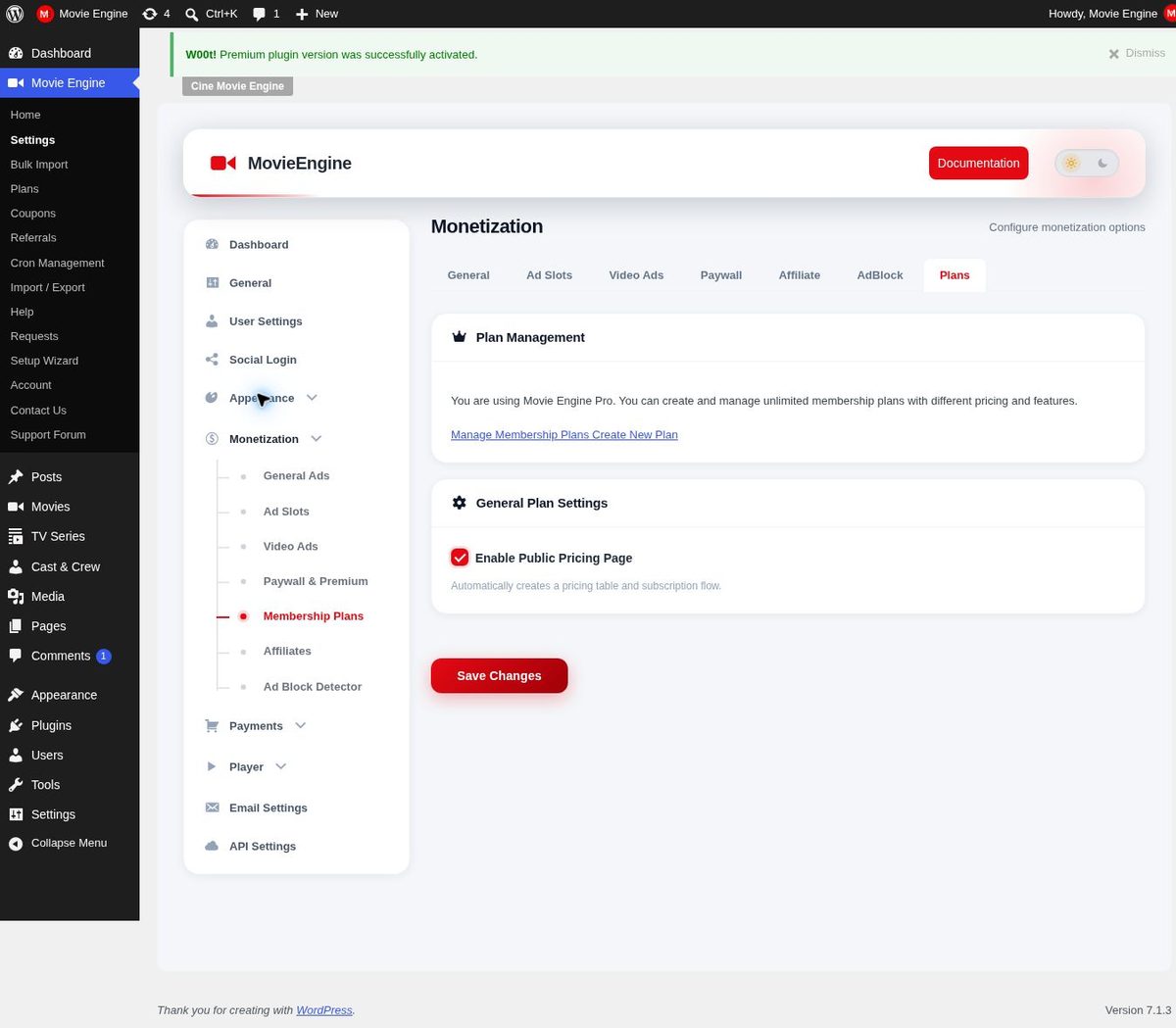
Free also provides the catalog: movies, series, seasons, episodes, and people, with genre, year, country, language, network, and tag taxonomies, cast and crew profiles, single-title TMDb import with duplicate detection, and an HLS and MP4 player with switcher, subtitles, and resume. Paid access, where a site offers it, is a Pro area, with subscriptions and pay-per-view; do not plan a site around paid access unless Pro is part of the build. Read the documentation and the installation guide before you commit, and try the live demo to see the catalog, title pages, and player in action.

10. Choose, then test before you commit
Choosing well means testing honestly. On a test site, import a handful of real titles, check a title page, a series page, and a people page, and run the full viewer journey: homepage to title page to playback and back to the dashboard. Ask whether each page explains itself without the rest of the site beside it.
That test is how a movie site’s SEO should be judged: tested, not assumed. The monetization overview in the documentation explains the available models, and current pricing for the plugin itself is separate from any prices you set for your own viewers.
Frequently asked questions
Does a plugin handle SEO on its own?
No. A plugin provides templates, structured data, and page structure, but the catalog work remains the site owner’s: complete metadata, consistent labels, and finished pages. Templates filled with half-finished metadata still produce half-finished pages.
What is the single most important SEO check for a movie site?
Open a title page, a series page, and a people page, and confirm each one stands alone with a clear title, a useful description, and its own structured data. If any page type fails that check, fix it before adding more titles.
How does internal linking help a movie site?
Internal links connect titles to the people who made them and the genres they belong to, so viewers can browse and search engines can follow the catalog’s structure. A site with no links between its pages reads as isolated pages, not as a library.
Does SEO change the rights a site needs?
No. Whichever tools are used, the site owner must hold the rights to every title offered for playback, and expired titles must be removed or renewed cleanly. The tools are a platform choice; the rights remain the site owner’s work.
Conclusion
Good movie website SEO is a sequence: consistent templates, standalone pages, labelled structured data, connected internal links, a predictable catalog, and regular performance checks. Follow that order, and the site becomes readable page by page.
If your plan involves a WordPress movie website SEO build, start with the checklist, publish only titles you have rights to, and test real pages the way viewers and search engines meet them. Then read the documentation, try the live demo, and check current pricing before you commit.
Related Posts


Comments (0)