
A watchlist is the simplest promise a movie site can make: “save this film now,…
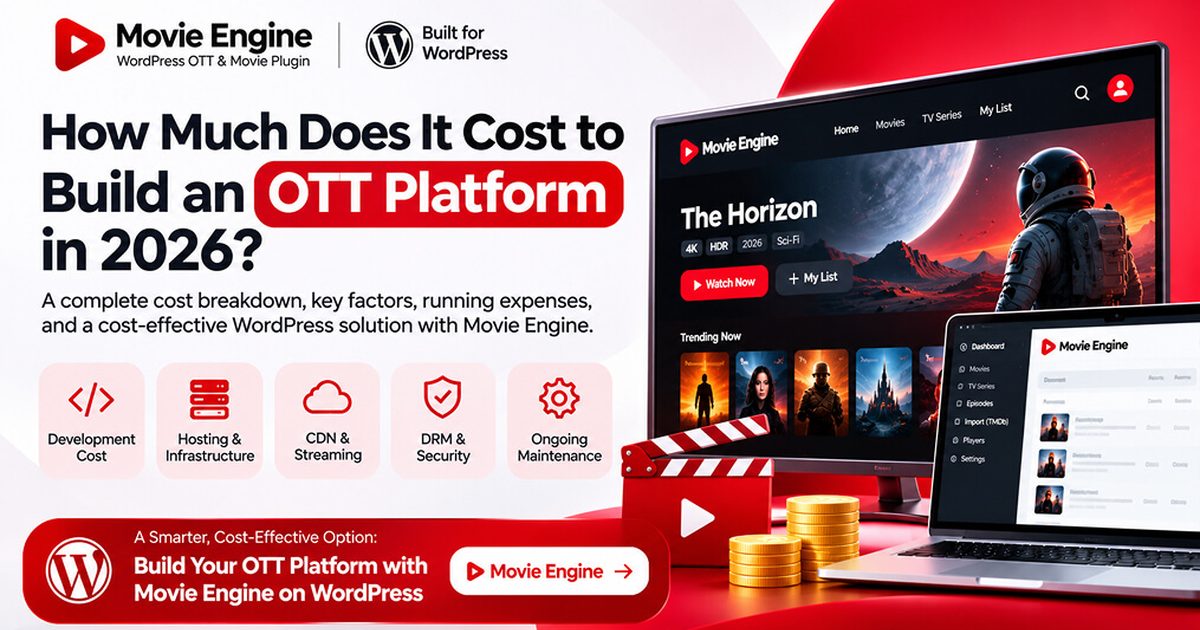
OTT Platform Cost: The Complete & Affordable Guide 2027
How much does it cost to build an OTT platform? In short, OTT platform cost is not one price: it is a build cost plus a running cost, and both change with the same five decisions: VOD or live, how many devices you launch on, whether you need DRM, how much video you deliver, and how you charge viewers.
This guide separates those two bills, shows the OTT platform cost bands that independent 2026 guides report for custom builds, and then explains a much cheaper third route for a catalog-style video site: starting from WordPress instead of building everything from scratch.
Quick answer
How much does it cost to build an OTT platform? A custom build is commonly estimated at $25,000–$800,000+ by scope, with running costs on top — indicative, not an industry average, and not fixed quotations.
- Custom build: $25,000–$800,000+ by scope.
- Running costs are separate and scale with watch time.
- WordPress plugin route avoids most custom build cost for a catalog site only.
What counts as an OTT platform?
OTT means video delivered over the internet, without a traditional cable or broadcast distributor in the middle. A typical platform has five systems, not one app:
- A catalog — movies, series, seasons, and episodes, with genres, cast, and search.
- Delivery — encoded video (usually HLS or DASH) sent through a CDN so playback adapts to each viewer’s connection.
- Playback — a player with quality selection, subtitles, and resume support.
- Accounts and access — sign-in, watchlists, and, for paid sites, subscriptions or rentals.
- Monetization — subscriptions (SVOD), pay-per-view (TVOD), advertising (AVOD), or a mix.
Cutting any one of those systems cuts cost. Adding live streaming, smart-TV apps, or studio-grade DRM adds it back, fast.
OTT Platform Cost Bands for a Custom Build
Use these bands as planning ranges for OTT platform cost, not promises. Where you land inside a band depends on scope, team location, and how many platforms you ship on day one. Third-party guides that report such bands include ForaSoft, RaftLabs, Akoode, RipenApps, and Oxagile. These are indicative ranges reported by individual agency guides, not industry-wide averages and not a surveyed mean — different guides use different scopes, team locations, and pricing models, so no single average figure is meaningful here.
| Build | Typical custom-build range reported in 2026 guides | What it usually includes |
|---|---|---|
| VOD MVP, web only or web + mobile | $25,000–$130,000 | Catalog, login, VOD upload, adaptive playback, basic analytics |
| Standard multi-platform VOD | $80,000–$350,000 | Web, iOS, and Android, stronger CMS, recommendations, full monetization |
| Advanced, with live streaming | $150,000–$400,000 | Live ingest, low-latency delivery, hybrid monetization, DRM where required |
| Enterprise, multi-region | $300,000–$800,000+ | Smart-TV apps, multi-DRM where required, ultra-low-latency live, large-scale CDN |
Timelines follow the same pattern: a focused MVP is often quoted at 8–14 weeks, a standard build at 5–10 months, and an enterprise build at 12 months or more.
Why do guides disagree? Because “OTT platform” means different products. A web-only VOD catalog and a live sports service with smart-TV apps are not the same build, even though both are called OTT.
The five cost drivers
1. VOD or live — or both
Recorded video on demand is the cheaper starting point. Live streaming needs ingest, live transcoding, low-latency delivery, and chat or DVR features, and it raises total OTT platform cost to build and to run.
2. How many devices you launch on
Web, iOS, and Android are the usual first three. Each smart-TV platform — Apple TV, Roku, Fire TV, Samsung Tizen, LG webOS — adds to OTT platform cost through engineering, testing, and store or certification work. Guides commonly put each additional TV platform in the tens of thousands of dollars.
3. DRM and content protection
For licensed studio content, licensors often require DRM, but DRM is not mandatory for every OTT site — it depends on your content rights and licensor terms, and for original or openly licensed content DRM may be unnecessary. Widevine (Android/Chrome), FairPlay (Apple), and PlayReady (TV) together are often quoted as a $20,000–$50,000 addition on its own, before any licensing fees. Watermarking and anti-screen-recording tools are a separate layer again.
4. Delivery: CDN, encoding, and storage
This is the running OTT platform cost that surprises most founders. Every hour watched moves gigabytes through a CDN, and CDN price per gigabyte varies widely by provider and volume. Encoding turns each upload into multiple quality levels, and storage grows with every title added. At small audiences these bills are modest; at scale, delivery is usually the largest monthly line.
5. Monetization complexity
A simple subscription is cheaper to build than a mix of subscriptions, rentals with expiry, vouchers, team accounts, and ad insertion. Each model needs its own access rules, payment handling, and transaction records.
The running cost after launch
Budget for these OTT platform cost items every month, on top of the build:
- CDN delivery, priced by data transferred and by region
- Encoding and storage, priced by minutes encoded and gigabytes stored
- DRM licensing and, where used, watermarking services
- Hosting, databases, and monitoring
- Maintenance, app-store updates, and support
- Content licensing or production, which is separate from technology cost and often larger than it
Several guides note that the initial build is only a minority of first-year OTT platform cost once delivery and operations are counted. A budget that covers only the build will run short in year one.
A cheaper third route: WordPress + a streaming plugin
A custom build makes sense when you need a proprietary app suite, unique compliance, or very large scale. For a catalog-style movie and TV site, there is a middle route: WordPress plus a dedicated streaming plugin.
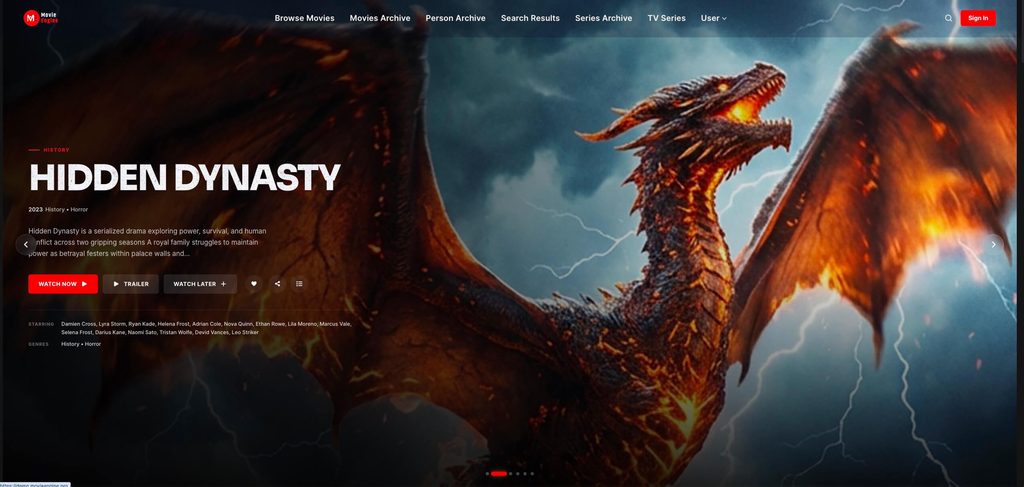
With Movie Engine, for example, the parts a custom team would rebuild already exist in the plugin (verified in version 1.0.8) (Free 1.0.8 and Pro 1.0.8, by ThemePul), and installation is documented in the setup guide:
- Free: movie, series, season, and episode management; single-title TMDb import; HLS and MP4 playback with a multi-server switcher and subtitles; watchlist, Continue Watching, and a user dashboard; Telegram publishing; SEO templates and structured data.
- Pro: subscription (SVOD) and pay-per-view (TVOD) access with Stripe and PayPal, bulk scheduled TMDb import, advanced DASH players and watermarking, video ads, and a voucher paywall.
That does not make the site free to run — you still need WordPress hosting, a video source or delivery setup, and rights to the content you publish — but it changes the OTT platform cost question from “how much to build a platform?” to “how much to launch and operate a catalog site?” For many small catalog and membership sites, that is the difference between a six-figure build and a site that can launch in weeks.
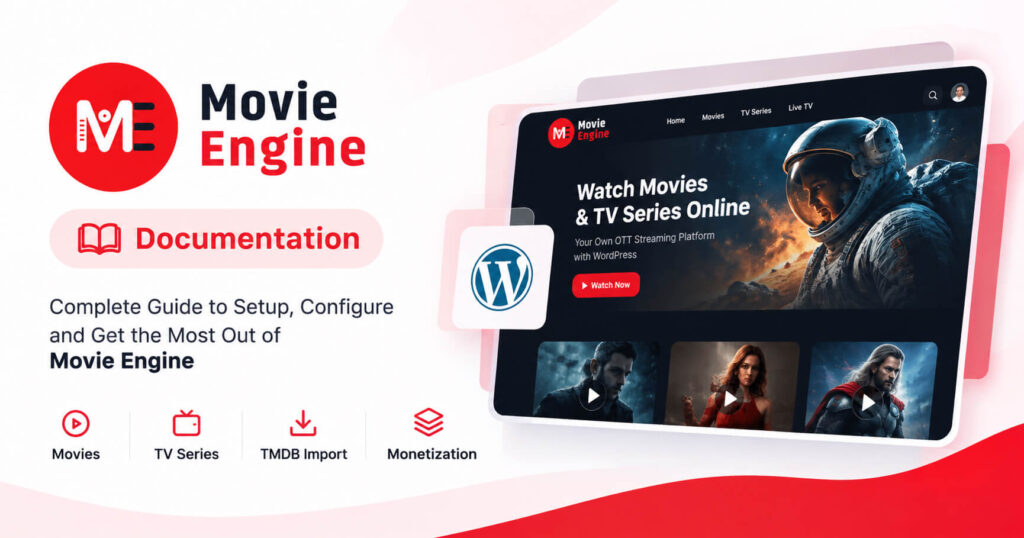
See the official demo and pricing pages to compare the current offering before deciding, and read the documentation for the exact feature boundaries between Free and Pro.
WordPress + Plugin vs Custom Development
| WordPress + Movie Engine plugin | Custom development | |
|---|---|---|
| Build cost | Plugin route avoids most custom build cost; you pay hosting, delivery, and content rights | $25,000–$800,000+ for a custom build, by scope |
| Time to launch | Can launch in weeks for a catalog site | MVP often 8–14 weeks; standard 5–10 months; enterprise 12 months or more |
| Catalog, player, users | Already included (Free catalog/player/users; Pro monetization) | Built from zero by your team |
| Mobile / smart-TV apps | A WordPress-based video site, not a custom app suite | Full custom app suite possible, at custom cost |
| Best for | Small catalog and membership sites | Proprietary app suite, unique compliance, very large scale |
Compare the two routes on your own scope before committing: read the documentation for catalog setup and TMDb import, try the live demo, and check current pricing.
How to budget in practice
- Write down your day-one scope in one sentence: VOD or live, which devices, paid or free, and how many titles at launch.
- Price the build and the first year of running costs separately when estimating OTT platform cost. Do not approve a build quote that hides delivery cost.
- Start with the smallest scope that proves demand, then add live, TV apps, or advanced DRM only when your content rights or licensor requires it.
- If your scope is a catalog VOD site, price the WordPress plugin route alongside the custom route before committing to a build.
- Get a written quote for your exact scope. No article, including this one, can replace it.
Common budgeting mistakes
- Budgeting only the build and forgetting the running OTT platform costs for CDN, encoding, and DRM.
- Launching on every TV platform on day one instead of proving demand on web and mobile first.
- Adding live streaming before the VOD catalog works reliably.
- Treating content licensing as a technology cost, or forgetting it entirely.
- Assuming a quoted MVP price includes subscriptions, DRM, and TV apps it does not mention.
Frequently asked questions
How much does OTT platform development cost?
There is no single number. Custom builds are commonly estimated from around $25,000 for a focused VOD MVP to $800,000 or more for an enterprise platform, plus monthly delivery and maintenance costs. Scope, devices, DRM, and live requirements decide where you land on OTT platform cost.
Is it cheaper to build or to use a platform?
For most small catalog sites, using an existing platform or a WordPress plugin is cheaper than a custom build, because the catalog, player, and user system already exist. A custom build pays off mainly at large scale or when you need something no existing product provides.
What is the highest ongoing cost?
Usually video delivery. CDN egress scales directly with watch time, so a popular title can raise the monthly bill far more than a quiet catalog does.
Does Movie Engine replace a custom OTT build?
No — and it does not claim to. It provides the catalog, import, player, user, and monetization building blocks for a WordPress-based video site. A fully custom mobile and smart-TV app suite is a different product with a different budget.
Conclusion
To plan OTT platform development cost, cost an OTT platform as two budgets, not one: a build budget driven by devices, live, DRM, and monetization, and a running budget driven by delivery and audience size. Get both in writing for your exact scope, start as small as demand allows, and compare the custom route with a WordPress plugin route before you commit to the larger bill. Planning OTT platform cost this way keeps build and running budgets separate.
Next step: if your plan is a WordPress movie site, read the documentation for catalog setup and TMDb import, try the live demo, and check the current pricing page — then budget hosting and delivery for your expected watch time.
Related Posts


Comments (0)